
In our earlier posts, we covered what SEO is, what AEO is, and how businesses can improve their visibility in modern search. But if your business serves customers in a specific town, estate, or neighborhood, there is another part of SEO you cannot ignore: Local SEO.
Think about a restaurant in Nakuru, a driving school in Eldoret, a real estate agency in Nairobi, a hospital in Kisumu, or a car wash in Naivasha. These businesses do not need to attract every customer in Kenya. They need to be visible when people nearby are looking for the products or services they provide.
A potential customer might search:
- “Restaurant near me”
- “Best hospital in Nakuru”
- “Real estate agents in Nairobi”
Or a potential customer might open Google Maps and search for a business nearby. That is where Local SEO comes in.
Table of Contents
What Is Local SEO
Local SEO is the process of improving your online presence so that your business can become more visible when people search for products or services with a local intent.
A local search can include a specific location, such as:
- “Airbnb in Nakuru”
- “Accountants in Eldoret”
- “SEO services in Nairobi”
Or the search engine may infer the location from the user’s context:
- “Restaurant near me”
- “Car wash near me”
- “Pharmacy near me”
Local SEO helps search engines understand the connection between your business, your services, and the locations you serve.
It’s the reason a “Local Pack” that box of three businesses with a map, star ratings, and phone numbers appears above the regular search results for so many searches. Local SEO is what gets you into that box.
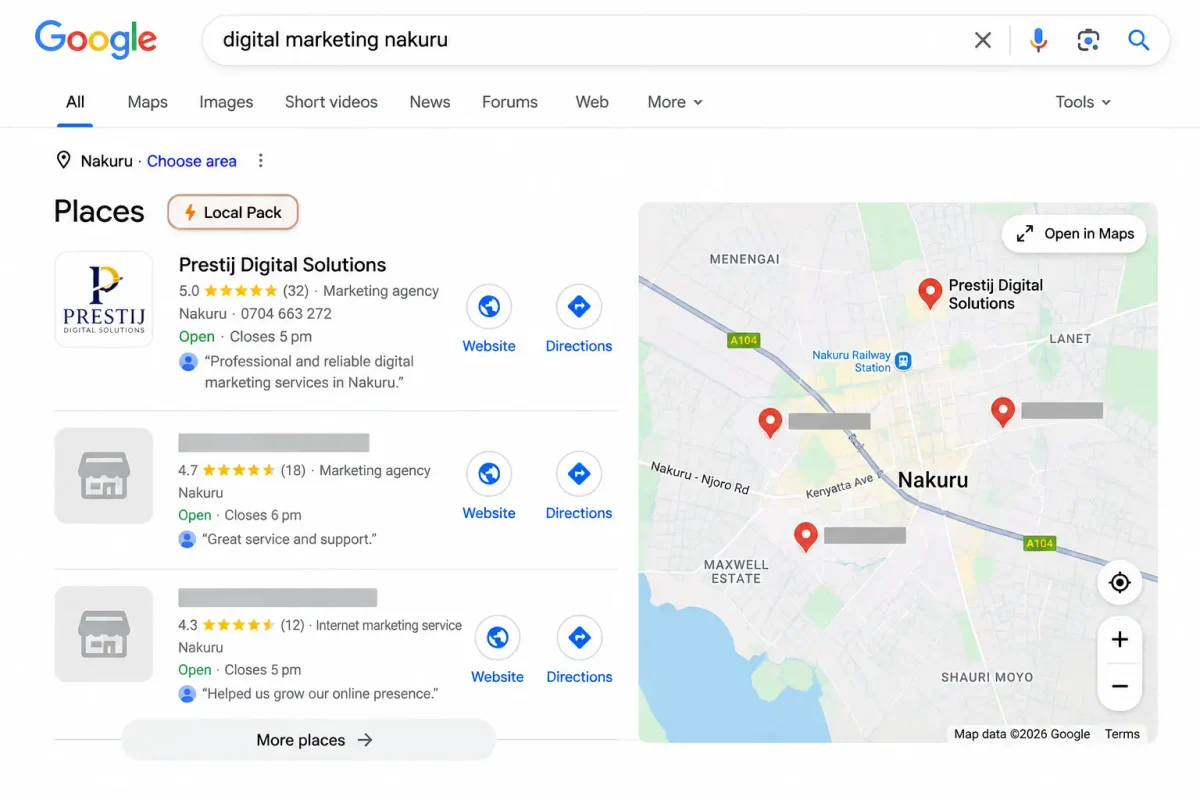
Your goal is not simply to appear in a map listing. It is to build a local online presence that makes it easier for potential customers to discover, evaluate, and contact your business.
Why Local SEO Matters for Kenyan Businesses
Most Kenyan businesses serve a specific town, estate, or region rather than the whole country. A car wash in Nakuru does not necessarily need customers searching from Mombasa. A driving school in Eldoret primarily needs to reach people who can actually attend its lessons. A restaurant in Nairobi needs visibility among people who can realistically visit its location.
Local SEO allows businesses to focus their online visibility on the customers they actually serve. It can be especially valuable when a search has strong purchase or visit intent.
Someone searching for: “Hardware shop in Eldoret”, “Restaurant near me”, “Dentist in Nakuru”,or “real estate agent in Nairobi” may already be looking for a business they can contact or visit.
Being visible at that moment can put your business in front of a potential customer when they are actively looking for what you offer.
Google Business Profile: A Foundation of Local SEO
For many local businesses, Google Business Profile (formerly Google My Business) is one of the most important parts of a local SEO strategy.
Your Business Profile can help your business appear across Google Search and Google Maps when people look for relevant businesses or services.
A well-maintained profile should provide accurate and useful information, including:
- Your correct business name
- Your address – where applicable
- Your phone number
- Your primary business category
- Relevant additional categories where appropriate
- Your opening and closing hours
- Your service area, if you don’t operate from a fixed storefront
- Photos of your business, products, premises or work
- A clear business description
- Your services or products, where available
The information should be accurate and kept up to date. This information should also be consistent across your website, social media profiles, and any other places on the internet.
Remember that completing your profile does not guarantee a particular position in local search. The goal is to give Google and potential customers reliable information about your business.
How Google Determines Local Results
Google explains that local results are primarily influenced by three broad factors:
Relevance
How well your business matches what the person is searching for.
If someone searches for “driving school in Eldoret,” a driving school offering services in Eldoret is more relevant to that search than an unrelated business.
Distance
How close the business is to the searcher or to the location included in the search.
For example, when someone searches for “restaurant near me,” the location of the searcher can influence which businesses are shown.
Prominence
How well-known a business is in the eyes of Google’s local search systems.
This can be influenced by information such as reviews, links, mentions, and other signals that help establish the business’s presence and reputation.
These factors work together, and local results can vary depending on the searcher’s location and the specific query.
6 Practical Ways to Improve Your Local SEO
Claim and Complete Your Google Business Profile
If your business is eligible for a Google Business Profile, claim and verify it.
Complete as many relevant fields as possible and make sure the information accurately represents your business.
Keep Your Business Information Consistent
Keep important information consistent across your website, Google Business Profile, social media profiles, and relevant directories.
Pay particular attention to your:
- Business name
- Address
- Phone number
- Website
- Business description
Consistency makes it easier for customers and search systems to understand your business.
Build Genuine Customer Reviews
Encourage genuine customers to leave reviews after using your products or services.
Do not buy reviews or create fake ones.
Respond to reviews professionally and use feedback to improve your customer experience.
Reviews can help potential customers evaluate your business before deciding whether to contact or visit you.
Create Location-Relevant Website Content
If your business genuinely serves multiple locations, create useful location-specific content where it makes sense.
For example, an SEO agency serving both Nakuru and Nairobi could have relevant pages explaining its services in each market.
Avoid creating thin pages that simply replace the city name while providing the same generic content.
Each location page should provide genuinely useful information for customers in that area.
Get Listed in Relevant Local and Industry Directories
Look for legitimate directories and industry listings that are relevant to your business and location.
Quality matters more than quantity. Avoid spammy directories created mainly to generate links.
Use Location Information Naturally
Where relevant, mention the towns, neighborhoods, and areas you genuinely serve in your page titles, headings, service pages, and content.
For example:
- “SEO Services in Nakuru”
can be useful when the business genuinely provides SEO services to customers in Nakuru.
The objective is to communicate location naturally—not to fill your pages with repeated location keywords.
Common Local SEO Mistakes to Avoid
Local SEO is not simply about adding your town name to every page. Avoid these common mistakes:
- Creating fake locations where your business does not operate
- Stuffing location keywords into content unnaturally
- Buying fake Google reviews
- Creating duplicate location pages with little unique value
- Listing inaccurate business information
- Using spammy directories solely for links
- Assuming that completing your Google Business Profile guarantees a top position
Local SEO works best when your online information accurately reflects your real business and the customers you genuinely serve.
How to Check Your Local Search Visibility
You can perform a simple local visibility check yourself. Search Google for:
“[your service] in [your town]” For example:
- “Real estate agents in Nakuru”
- “Driving school in Eldoret”
- “SEO services in Nairobi”
Then check Google Maps for the same type of search. Ask yourself:
- Can I find my business?
- Is the business information accurate?
- Is the correct category being used?
- Are the opening hours correct?
- Does the profile have recent reviews?
- Does the website clearly explain the services I offer?
- Does my website provide useful location-specific information?
Remember that local results can vary based on the searcher’s location and the exact wording of the search. One search is therefore not a permanent ranking test.
Instead, use the exercise to identify opportunities to improve your local online presence. Local SEO and the Bigger Search Picture
- Local SEO is part of a broader online visibility strategy.
- SEO helps your website become discoverable through search.
- AEO focuses on making your information easier for answer-oriented search systems to understand and potentially use.
- Local SEO adds another important dimension: location.
For a local business, the question is not simply: “How can I get more website traffic?”
It is also: “How can I become easier to find when people in the areas I serve are looking for what I offer?” That is why your website, Google Business Profile, reviews, business directories, and other online information should work together rather than exist as disconnected pieces.
Frequently Asked Questions About Local SEO
What is Local SEO?
Local SEO is the process of improving your online presence so your business becomes more visible when people search for products or services with a local intent — either a specific location typed into the search, or a location Google infers from the searcher’s context.
Is Local SEO different from regular SEO?
Local SEO is a specialized part of SEO. Regular SEO focuses on your overall visibility in search, while Local SEO focuses specifically on visibility for searches tied to a location — such as appearing in the Local Pack or on Google Maps.
Do I need a physical store to benefit from Local SEO?
No. If your business serves a specific service area rather than operating from a fixed storefront, you can still set up a Google Business Profile and specify your service area, which allows you to appear in relevant local searches.
How long does it take to see results from Local SEO?
There’s no fixed timeline. It depends on factors such as how complete your Google Business Profile is, how much competition exists in your town or industry, how consistent your business information is online, and how many genuine reviews you have.
Does having a Google Business Profile guarantee I’ll rank at the top?
No. A complete, accurate profile improves your chances of being found, but Google’s local rankings are influenced by relevance, distance, and prominence together — no single step guarantees a top position.
Can buying reviews or using fake locations speed up my results?
No — and it can actively hurt you. Fake reviews and fake locations violate Google’s policies and can get your listing suspended or removed entirely. Genuine reviews and accurate information are the only sustainable path.
How often should I check my Local SEO performance?
A quick self-check every few weeks is enough for most small businesses — search for your own service and town, check Google Maps, and confirm your profile information is still accurate. Results can vary by searcher location and search wording, so treat it as an ongoing habit rather than a one-time test.
What’s the single most important first step for a Kenyan business starting Local SEO?
Claiming and fully completing your Google Business Profile. It’s free, it’s the foundation everything else builds on, and it’s usually the biggest visibility gap for small businesses that haven’t touched it yet.
Take Action
Search Google Maps right now for:
“[your service] in [your town].” Then look at the businesses that appear. Check your own listing and ask:
- Is the information accurate?
- Is your business easy to understand?
- Are your services clearly described?
- Do you have genuine customer reviews?
- Does your website support your local visibility?
If you are not sure what is holding your local presence back, send Prestij Digital Solutions your search results on WhatsApp at 0704 663 272.
We can help you identify opportunities to improve your Google Business Profile and broader local search visibility.