
In our previous guide, What Is SEO? A Practical Guide to Online Visibility for Kenyan Businesses, we explored how Search Engine Optimisation helps businesses become more visible when potential customers search online. We now focus on What is AEO because there has been changes and expansion in the way people search and consume information.
Traditional search engines remain important, but people can now use AI-powered platforms such as ChatGPT, Gemini, and Perplexity to ask questions. They are increasingly using AI-powered platforms to research businesses, compare options, and to find information in a more question-and-answer conversational way.
For example, someone looking for property services might ask:
- “Which real estate agencies in Nakuru can help me find land?”
Someone looking for professional services might ask:
- “Which accounting firms in Eldoret offer KRA compliance services?”
Instead of simply receiving a list of links, the user may receive an AI-generated response that summarizes information and points them toward relevant sources.
This creates a new question for business owners:
If customers are asking AI-powered systems questions about businesses, how can my business make its information easier to understand and discover?
This is where Answer Engine Optimization (AEO) becomes relevant. You first need to understand what is AEO.
Table of Contents
What Is AEO?
AEO stands for Answer Engine Optimization.
AEO is the practice of creating and structuring your content and online presence so that answer-oriented search systems can better understand, interpret, and potentially use your information when answering relevant questions.
In simple terms, AEO is about making your business information easier to understand when people search for answers, not just when they search for websites.
For example, imagine a potential customer asks:
- “Which real estate companies in Nakuru can help me buy land?”
For your business to be considered relevant, it needs to be clear what your business is, where you operate, what services you provide, and why the information about your business is credible.
Compare these two descriptions they illustrate what is AEO:
| Vague: | Specific: |
| “We provide innovative solutions designed to empower our clients and deliver sustainable results.” | “ABC Properties is a real estate company in Nakuru that helps clients buy and sell residential and commercial property.” |
The second description communicates much more useful information.
It tells the reader:
- Who the business is
- What industry it operates in
- Where it operates
- What services it provides
That clarity matters because answer-oriented search experiences need to interpret information before they can potentially use it in a response.
AEO Is More Than Keywords
To correctly understand what is AEO you need to know that AEO is not simply about inserting keywords into your website or trying to manipulate an AI system into recommending your business. It is about building an online presence where important information is:
Clear. Useful. Structured. Accessible. Credible.
That means answering real customer questions, explaining your services clearly, demonstrating genuine expertise, and maintaining accurate information across your online presence.
AEO also does not mean abandoning SEO.
Your website still needs the technical and content foundations that allow search engines to discover and understand your information. Traditional SEO focuses heavily on helping search engines discover, understand, and rank your content.
AEO builds on those foundations by putting greater emphasis on how information can serve people who are looking for answers.
SEO vs AEO: What is the Difference?
SEO and AEO are closely related, but they focus on different aspects of the search experience.
SEO
Search Engine Optimization (SEO) helps search engines discover, understand, and rank your website and its content for relevant searches.
For example, a potential customer might search:
- “Real estate companies in Nakuru”:
SEO can help your website compete for visibility when that search is performed.
AEO
AEO focuses on making information easier for answer-oriented search systems to understand and potentially use when responding to questions.
For example, a potential customer might ask:
- “What should I consider when choosing a real estate company in Nakuru?”
An answer-oriented search experience may provide a response that brings together information from several sources rather than simply presenting a list of websites.
The Difference in Simple Terms: Think of it this way
| What is SEO? | What is AEO? |
| Focuses on search visibility | Focuses on search visibility |
| Helps search engines understand and rank content | Helps answer systems interpret and potentially use information |
| Often targets searches and keywords | Often addresses questions and information needs |
| Can lead users to your website | May provide information directly within the answer experience |
| Relies on strong content and technical foundations | Builds on those foundations with clear, structured information |
They are not competing strategies.
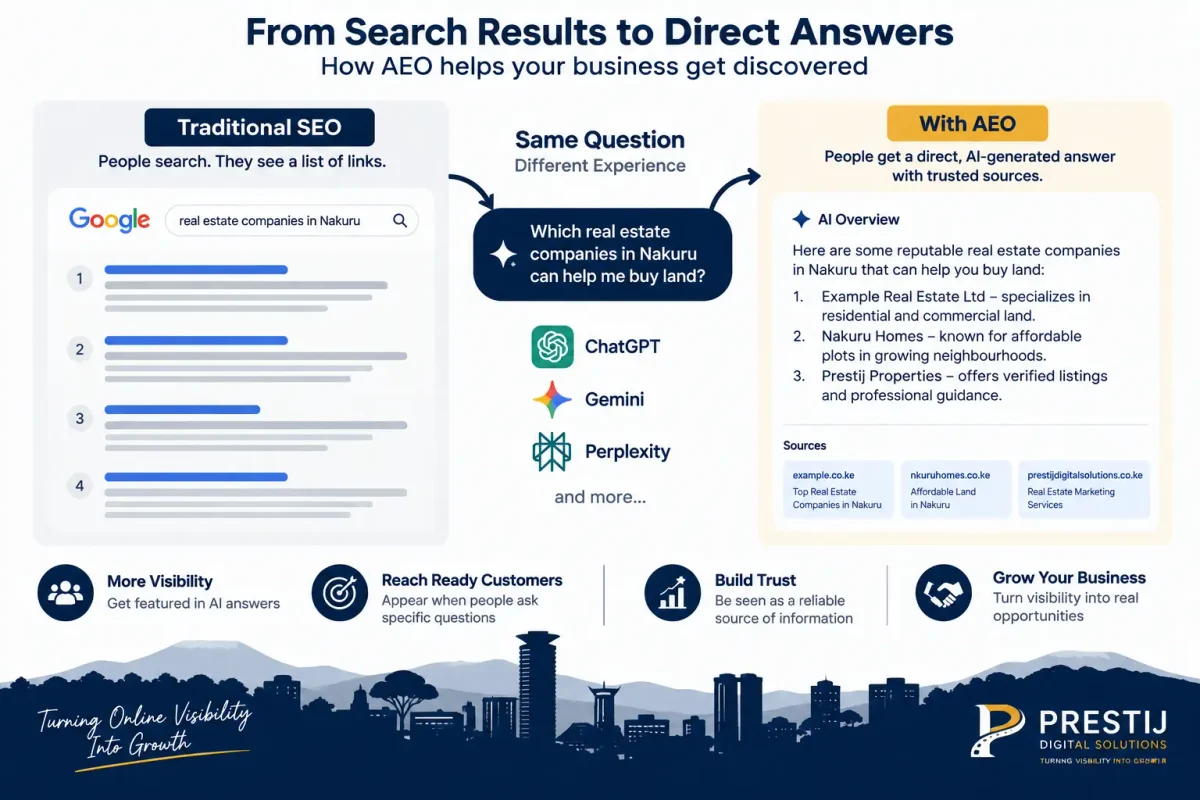
SEO helps your information become discover-able in search. AEO helps make that information easier to understand and use in answer-oriented search experiences.
AEO does not replace SEO.
A strong AEO strategy benefits from the foundations of good SEO: accessible pages, useful content, clear site structure, relevant information, internal linking, technical accessibility, and credibility. Google’s current guidance for its generative AI search features similarly states that established SEO fundamentals remain relevant.
How Do AI Answer Engines Find Information?
This is where most people misunderstand what is AEO. There is no universal checklist that guarantees an AI system will mention your business. Different platforms use different technologies, sources, and processes to determine which information may be relevant to a user’s question. What businesses can do is improve the quality, accessibility, and clarity of the information available about them.
Several areas are particularly important.
1. Clear and Direct Answers
AI systems and people need to understand what your business actually does. Consider these two statements:
- “We provide innovative solutions designed to empower businesses to achieve sustainable growth.”
- “Prestij Digital Solutions provides SEO, AEO, Local SEO, and digital marketing services for businesses in Kenya.”
The second statement is much more specific. It answers:
- Who are you?
- What do you do?
- Who do you serve?
- Where do you operate?
In this case:
- Who is Prestij Digital Solutions? — It’s a digital marketing service provider.
- What does Prestij Digital Solutions do? — It provides SEO, AEO, Local SEO, and digital marketing services.
- Who does Prestij Digital Solutions serve? — It serves businesses in Kenya.
- Where does Prestij Digital Solutions operate? — It is based in Nakuru, Kenya.
Your important business information should not be hidden behind vague marketing language.
2. Well-Structured Content
Good structure makes information easier for people to read and easier for search systems to interpret. Use:
- Clear headings
- Short paragraphs
- Numbered steps
- Bullet points
- Descriptive page titles
- Internal links
- Tables where useful
- Question-and-answer sections
- Clear definitions
For example, instead of creating one large page called “Our Services,” you could organize it into clearly defined sections such as SEO Services, AEO Services, Local SEO, Google Business Profile Optimization, Content Strategy, and Technical SEO. Each section communicates a specific subject.
3. Consistent Business Information
Imagine that your website says your business is based in Nakuru and provides SEO services. Your Google Business Profile says something different. Your LinkedIn page describes a completely different service offering. And a directory lists another location.
A customer may become confused. Consistent information across your website, Google Business Profile, social media profiles, business directories, industry listings, and other legitimate online mentions helps create a clearer picture of your business.
Keep important information such as your business name, location, services, contact information, and business description as consistent as reasonably possible.
4. Demonstrated Expertise and Credibility
Simply publishing hundreds of articles does not automatically make a business authoritative. The quality and usefulness of the information matter. Businesses can demonstrate expertise through detailed educational content, first-hand experience, original research, case studies, examples, author information, accurate references, genuine customer reviews, relevant industry mentions, and useful resources.
For example, a Kenyan accounting firm could publish a detailed guide explaining common KRA compliance questions faced by small businesses. That is more useful than publishing dozens of shallow articles simply because they contain keywords. The objective should be to create information worth trusting and using.
5. Genuine Mentions, Reviews and References
Your website isn’t the only place where your business exists online. Other legitimate sources can also contribute to your digital presence, including Google reviews, relevant business directories, industry publications, local media, professional associations, business partnerships, and other reputable websites.
The emphasis here should be on genuine recognition. Buying fake reviews, manipulating links, or creating large amounts of low-quality content is not a sustainable AEO strategy.
Why Does AEO Matter for Kenyan Businesses?
Think about how a potential customer might research a business today. They could search Google, check Google Maps, visit several websites, read reviews, check social media, ask friends or colleagues, or ask an AI-powered search tool.
The customer’s journey can therefore involve several different discovery environments. Consider these questions:
- “What documents do I need to register a business in Kenya?”
- “Which driving schools in Eldoret offer driving lessons?”
- “Which real estate companies in Nakuru sell land?”
- “How much does SEO cost in Kenya?”
These are not simply keyword searches. They are questions, and modern search increasingly gives users answers rather than requiring them to manually visit ten different websites. That makes the quality and clarity of your online information increasingly important.
Next: How to Start Optimizing for AEO
Understanding what is AEO and why it matters is the first step. In Part 2, we walk through exactly how to start optimising your own website for AEO — from finding the questions your customers actually ask to structured data to testing whether your business already shows up in AI search results today.
Frequently Asked Questions About AEO
What is AEO?
AEO, or Answer Engine Optimization, is the practice of creating and structuring your content and online presence so that answer-oriented search systems can better understand, interpret, and potentially use your information when answering relevant questions. In simple terms, AEO is about making your business information easier to understand when people search for answers, not just when they search for websites.
What is the difference between SEO and AEO?
SEO focuses on improving a website’s visibility in traditional search results, while AEO focuses on making information clear, structured, and useful for systems that provide direct answers to users. The two approaches complement each other rather than replace one another.
Why does AEO matter for Kenyan businesses?
AEO can help Kenyan businesses make their information easier for search and answer systems to understand when potential customers ask questions about products, services, or businesses in Kenya.
Does AEO replace SEO?
No. AEO does not replace SEO. A strong AEO strategy benefits from the foundations of good SEO, including accessible pages, useful content, clear site structure, relevant information, internal linking, technical accessibility, and credibility. AEO builds on these foundations by placing greater emphasis on how information can serve people looking for answers.
How can Kenyan business start optimizing for AEO?
Kenyan businesses can start by making their business information clear, useful, structured, accessible, and credible. Clearly explain who you are, what you do, who you serve, and where you operate. Businesses should also create useful content that answers real customer questions, maintain consistent business information across legitimate online platforms, and demonstrate genuine expertise and credibility.