
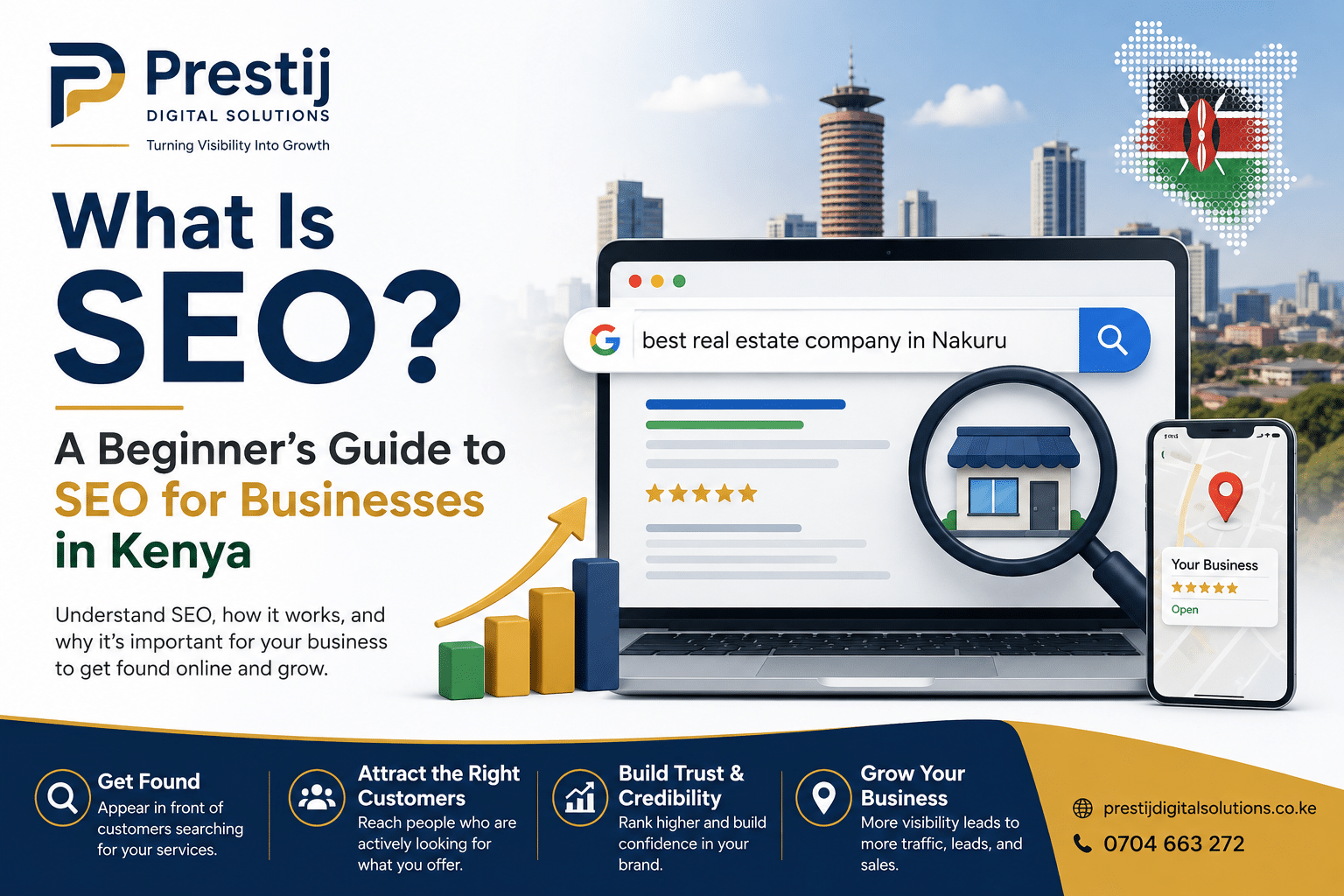
What is SEO, and why does it matter to businesses in Kenya? Every day, people across Kenya use Google and Google Maps to search for products, services, and local businesses. They type in phrases like “Best places in Nairobi to buy phones,” “the best real estate company in Nakuru,” “Driving School in Eldoret,” or “best Airbnb in Mombasa.”
Your business might offer exactly what these customers want. But will they find your business among the many search results? If you search for your business on Google right now, where do you appear? Are you on the first page, somewhere farther down, or nowhere in the search results?
Table of Contents
What Is SEO?
So, what is SEO? SEO stands for Search Engine Optimization. It is the intentional process of improving your website and online presence so that search engines can understand your content and its relevance to a search. For Kenyan businesses, a strong SEO strategy is a powerful way to attract potential customers organically – without relying entirely on paid advertising like Facebook, TikTok, or Google Ads.
Effective SEO is built on three broad areas: On-Page SEO, Technical SEO, and Off-Page SEO.
1. On-Page SEO (Content, Information, and Intent)
On-Page SEO involves optimizing content directly on your website’s individual pages to ensure they are useful and highly relevant to what users search for on Google.
This includes:
- Targeting relevant keywords and phrases
- Matching user search intent
- Creating and publishing high-quality, useful content
- Optimizing URLs, headings, and page titles
- Image optimization and descriptive alt text
- Building clear internal links between related pages
Keyword Research, Search Intent, and Technical Foundations
For example, if you operate a real estate agency in Nakuru, including relevant terms such as “land” and “Nakuru” on your website can help communicate what your business offers and where you operate. However, keywords alone are not enough. You must understand the deeper user search intent behind those keywords.
A user searching for “Plot for sale in Nakuru” has a different intention from someone searching “documents needed when buying land in Kenya.” One user is likely looking for properties to buy, while the other is looking for information about the buying process. Creating content that matches what users are actually looking for is the essence of satisfying search intent and is an important part of modern On-Page SEO.
2. Technical SEO (Performance and Crawlability)
Technical SEO focuses on the underlying infrastructure of your website. Technical problems can make it harder for search engines to crawl and understand your website. This creates a poor experience for visitors. Key technical areas include:
- Website structure and Website loading speed
- Mobile usability: Ensuring a perfect mobile experience (This is very important since most Kenyans browse via mobile)
- Crawlability and Indexing: Ensuring Google’s bots can seamlessly access and log your pages.
- Site security: Securing user data with active HTTPS/SSL encryption.
3. Off-Page SEO (Authority and Credibility)
Off-Page SEO refers to all activities outside your own website domain that signal trust to search engines. The most important part of Off-Page SEO is backlinks.
A backlink is a link from another website pointing to your website. These links help search engines discover your pages and provide signals about their relationship, relevance, and authority. However, modern SEO is not about collecting as many backlinks as possible. Quality, relevance, and credibility matter, and attempts to manipulate links can violate search engine spam policies.
How Does SEO Work? & Why does SEO matter?
When someone searches on Google, the search engine evaluates hundreds of signals to serve the user with the most reliable answer. Some of the signals include;
- What is this website about?
- Does this page answer the searcher’s question?
- Is the information useful and trustworthy?
- Can the website provide a good experience for visitors?
- Is the business relevant to the location being searched?
If someone searches for “Best Airbnb in Nakuru,” Google uses its search systems to determine which results are most relevant and useful for that particular query. SEO helps you make your website and business information clearer, more accessible, and more relevant to the searches that matter to your customers.
Why Should a Kenyan Business Owner Invest in SEO?
You should definitely invest in SEO. If potential customers are actively searching online for what you offer and your business isn’t visible, you are handing your competitors a free opportunity to win those clients instead.
- Attract more customers who are actively looking to buy your products and services
- Improve your visibility in local search and Google Maps
- Build digital credibility and long-term brand authority
- Reduce dependence on paid advertising over time
Strategic Application & Next Steps:
SEO Strategies are different for every industry;
Hospitality: A restaurant in Nakuru could target searches related to restaurants and dining in Nakuru.
Real Estate: A real estate company in Nairobi could target searches related to properties and real estate services in Nairobi.
Accommodation: An Airbnb in Mombasa could target searches from people looking for accommodation and things to do in Mombasa.
Professional Services: An accounting firm in Eldoret could create useful content around accounting, tax, bookkeeping, and business compliance questions relevant to its customers.
Modern SEO: From Search Engines to AI Answers
Now that we have answered the question What is SEO? it is important to recognize that search is changing. People are no longer relying only on traditional search results. They are increasingly using AI platforms like ChatGPT, Gemini, and Perplexity to search, ask questions, research products and services, compare options, and find information.
However, this does not mean that traditional SEO is becoming irrelevant. In fact, Google’s official documentation confirms that many of the same SEO fundamentals that help search engines discover, understand, and evaluate content also remain relevant to modern SEO and AI-powered search experiences.
This is where Answer Engine Optimization (AEO) becomes relevant. AEO focuses on making information clear, structured, useful, and easier for AI-powered search and answer systems to understand and potentially surface when users ask relevant questions.
SEO is not just a technical checklist; when well done, it can become a source of relevant traffic, enquiries, and business opportunities, creating a long-term revenue engine.
Take Action:
Go to Google right now and search for your primary service in your city. Where does your business rank? Text your findings directly to our founder, Peter Kungu, on WhatsApp at 0704663272 for a quick SEO visibility check!